Les actions éducatives
Young Critics Lab
22 décembre 2025
Les Arcs 2025: Alpine Ambition, Uneven Access
By Edin Custo
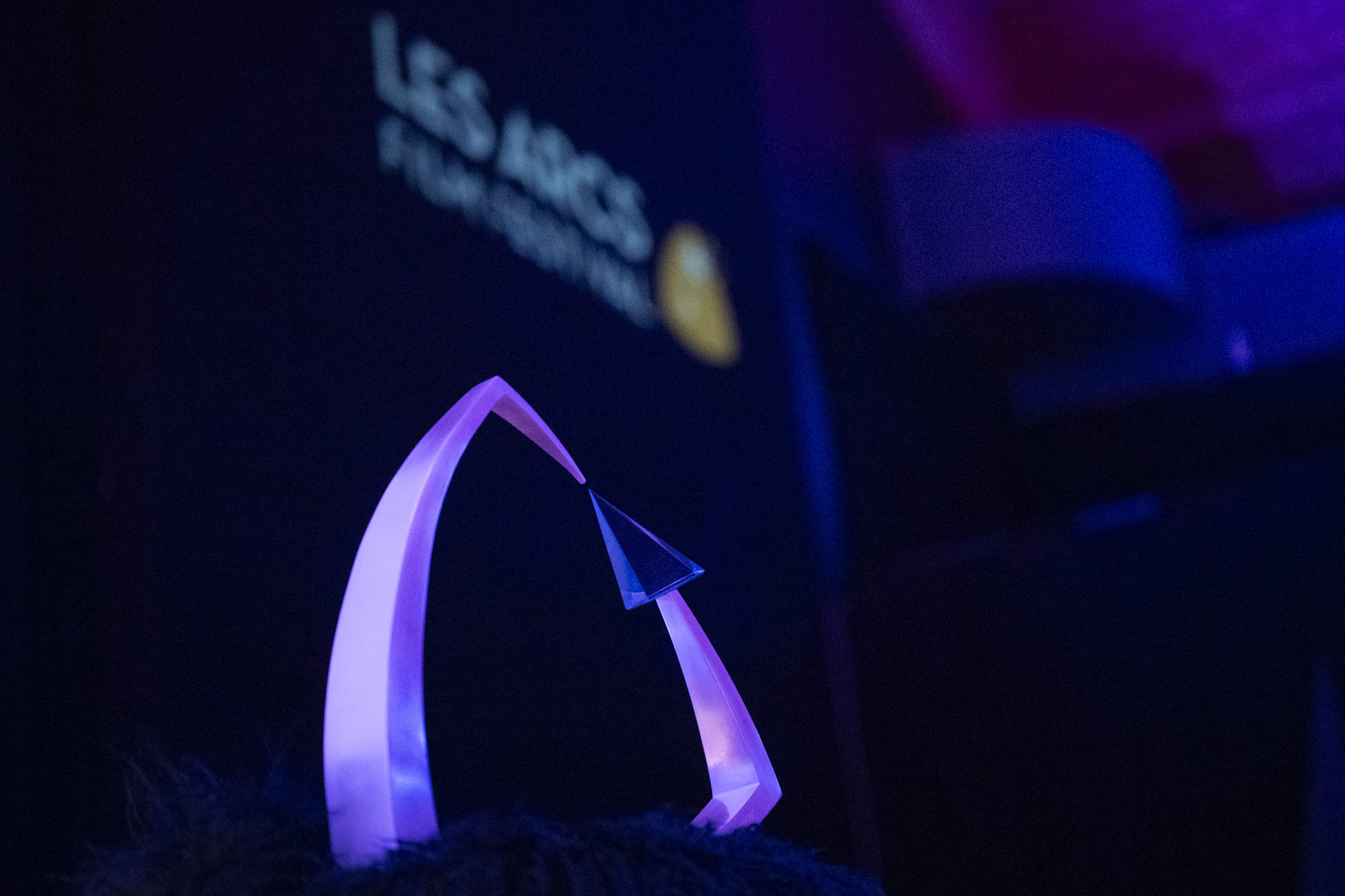
As Sundance prepares to take place in Park City, Utah, for the last time before moving to the foothills of Boulder in Colorado, the 19th edition of Les Arcs Film Festival – often billed as the European Sundance – screened 134 films against the backdrop of the French Alps.
The line-up stretched across feature and short competitions, with the “Hauteur” section dedicated to auteur cinema, a spotlight on Greek films and a showcase of European submissions for Best International Feature called “Oscar on Skis.” There were also premieres and special screenings, including works by guests of honor and films themed around democracy. The program also included “Playtime,” the festival’s feel-good strand, a youth program and “Summit Movies,” a series devoted to how cinema is evolving in the digital era and the age of ubiquitous streaming.
A recurring theme throughout the selection was a kind of thematic split. The feature competition leaned towards more universal, character-driven dramas: Solomamma and Father circled parenthood, guilt, and grief, while Little Trouble Girls and Maspalomas offered variations on the themes of coming of age – and coming of old age. I Swear addressed the experience of being different and Three Goodbyes, as the title suggests, focused on death. Silent Friend studied the human condition through the stationary life of a tree, while Mr. Nobody Against Putin turned the political situation into a one-man confrontation. In contrast, the shorts were far more overtly political, with topics ranging from sexual abuse in academia in Beyond Silence to young men and the internet in No God No Father, and the perception and treatment of a Roma boy in The Spectacle.
Introduced in 2022, “Oscar on Skis” is not the only section of its kind on the festival circuit, but its timing gives it particular significance. Taking place during the week when the Academy of Motion Picture Arts and Sciences announces its shortlist of 15 films for Best International Feature (along with shortlists in other categories), it encourages audiences to watch these titles with an eye on the competition. This year’s edition included Sound of Falling, which ultimately made the shortlist, and The Tale of Silyan, which was widely considered a strong contender but did not make the cut. Oliver Laxe served as the festival’s talent ambassador, and his film Sirāt ended up shortlisted in five categories, including the Academy’s newest: Best Casting.
As it grows, Les Arcs has also been reshaping itself. In its earlier years, according to its founders, the festival’s identity was clearly divided between a competitive section geared towards auteur and arthouse cinema, and a non-competitive section built around more accessible French premieres with recognizable faces. The festival’s General Manager, Guillaume Calop, has described how expanding its structure has helped bring different audiences together, notably by creating strands like “Playtime” for entertaining crowd-pleasers and “Hauteur” for more formally ambitious emerging work. Still, some frictions remain.
While at the festival, I attended a screening of the Spanish film Maspalomas which prompted a noticeable walkout. It follows a 76-year-old gay man, financially unstable, who is forced into a nursing home and cut off from the queer refuge that places like Maspalomas have come to embody. The opening is strikingly explicit and a number of older spectators left during it. The synopsis did not signal that level of intensity, which suggests there is room to fine tune how content expectations are communicated. More broadly, the same questions of access and framing arose elsewhere. Some French titles were not subtitled in English, which can limit access for international guests and industry visitors.
Another notable absence was a flagship Palestinian film, of the kind that many fall festivals have featured this year. Examples include The Voice of Hind Rajab, All That’s Left of You, Palestine 36 and Put Your Soul on Your Hand and Walk, all of which were shortlisted for Oscars either in the Best International Feature or Documentary categories. When I spoke to the festival’s Artistic Director, Frédéric Boyer, he said that eligibility for selection was “based on European production.” He did mention All That’s Left of You, however, produced by Greek-German filmmaker Thanassis Karathanos, calling it “really interesting and not political.” Regarding The Voice of Hind Rajab, he was more categorical, saying he “opposed” the film. It incorporates the real emergency call recording of Hind Rajab, a Palestinian girl who was killed, and it intentionally pushes the boundaries of documentary ethics and form.
At the closing ceremony on Friday night, the festival handed out 12 awards, plus a special mention for a short film in the competition category. The top prize, which includes a €40,000 digital campaign on the France Télévisions website to promote the film upon its French release, went to Mr. Nobody Against Putin, which also took Best Original Soundtrack, an award endowed with €1,000 from SACEM (the Society of Authors, Composers and Publishers of Music).
As the Oscar shortlists were announced, the five-member jury, presided over by director Dominik Moll, was still deliberating. Mr. Nobody Against Putin scored a place on the Best Documentary Feature one, so perhaps the timing nudged perceptions, even subconsciously. The Grand Prix du Jury went to Urška Djukić’s Little Trouble Girls, Slovenia’s Oscar submission, which did not make the shortlist.
The most decorated title of the night was the British film I Swear, based on the true story of a young man living with Tourette’s syndrome in the 1980s. It won the Youth Prize, the Audience Award, and one of the festival’s two interpretation prizes. The other went to Milan Ondrík for Father, Slovakia’s unsuccessful Oscar submission. Les Arcs does not categorize its acting awards by gender, and this year both went to men. This is worth noting not as a criticism, but as a reminder that gender-neutral categories do not automatically translate to balanced outcomes. One possible alternative would be to distinguish lead and supporting performances, but the festival has opted for a different approach.
The award for Best Cinematography went to Silent Friend for its ability to create a distinct visual style for each of the film’s three eras, as seen from the point of view of a tree. Maspalomas received the Cineuropa Award for its portrayal of a challenging and frequently overlooked demographic of older gay men. Isabel Coixet’s Three Goodbyes won the Grand Award of the Cinglés du Cinéma. In the short film category, the Best Short Film award went to Marnie Blok’s Beyond Silence, with a special mention for Jocelyn Charles’ God Is Shy. Finally, the Youth Jury Prize went to Mikkel Storm Glomstein’s Extermination d’animaux de compagnie. The festival closed with a screening of Jean Paul Salomé’s L’affaire Bojarski.
At an altitude of roughly 2,000 meters above sea level, Les Arcs is one of the highest film festivals in Europe, and it embraces this setting as part of its identity rather than merely a backdrop. You can see it in the branding, which has just the right amount of cheesiness (after all, we are in France): “Oscar on Skis,” “Hauteur” (a neat double entendre nodding to both height and auteur cinema) and the Slope of Fame, a mountain twist on the Walk of Fame. As the festival’s leadership and staff took to the stage in “mountain chic,” the communal nature of the event was impossible to miss, proving the old adage that it takes a village – or, in this case, a mountain – to pull it off. In the words of Frédéric Boyer, film festivals have become “distributors,” and Les Arcs makes that idea literal by shaping not only what is seen, but also how far it travels.