Les actions éducatives
Young Critics Lab
22 décembre 2025
Isn’t it a sin? Review of Little Trouble Girls
By Tobiasz Dunin
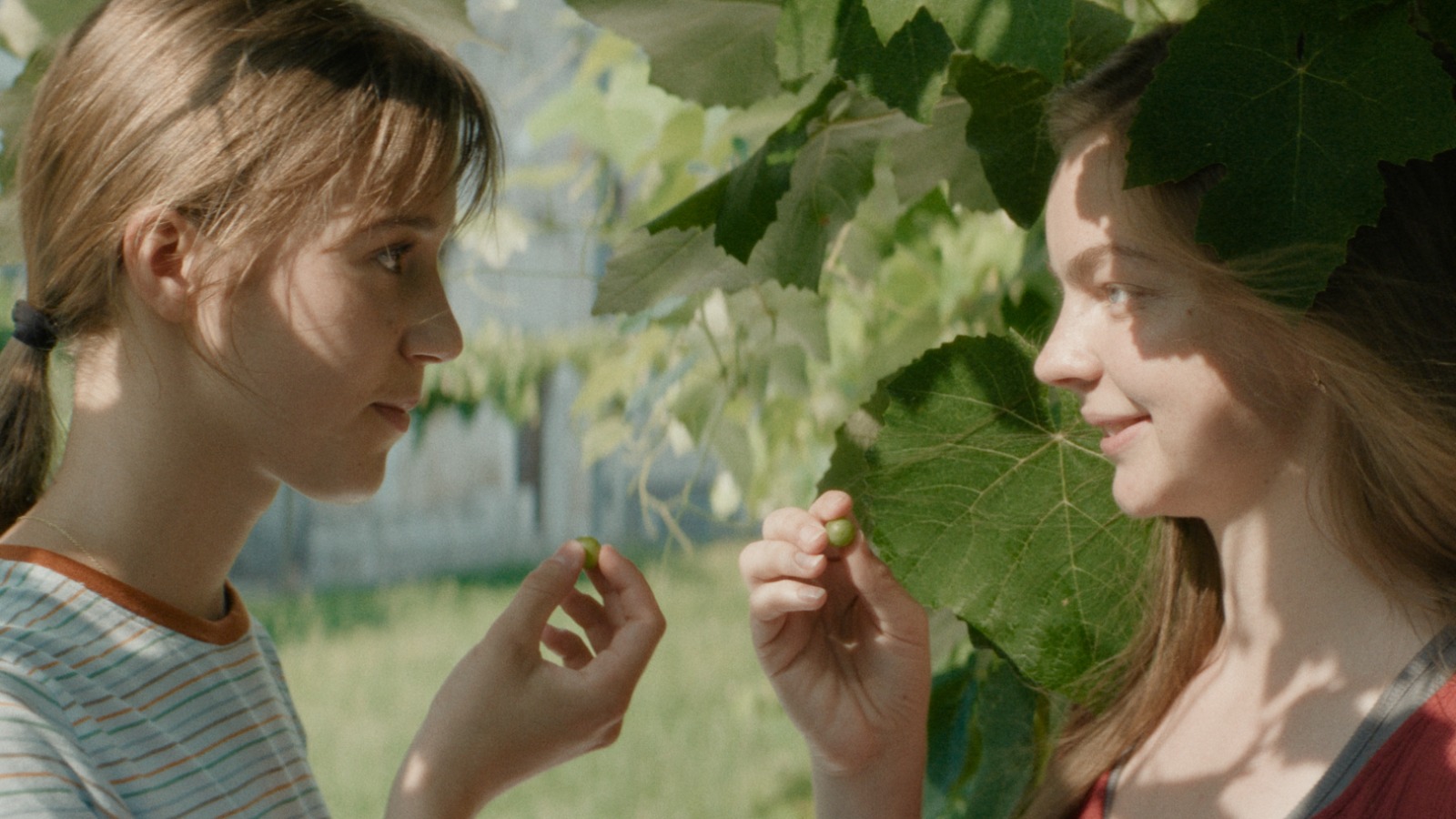
Not every country has the courage to submit a debut film for the Best International Feature Film at the Academy Awards, as Slovenia did this year with the coming-of-age drama Little Trouble Girls. Although it didn’t make the shortlist, it’s fair to say that Urška Djukić – already awarded a few times for her shorts – created a solid movie about self-discovery. It premiered at the 75th Berlin International Film Festival and was screened at numerous festivals, including Tribeca Film Festival and Les Arcs.
Opening with a black screen and the sound of inhaling and exhaling, before moving onto an image resembling a vulva, Djukić sets the tone for the rest of the screening. It’s filled with stress, caused not only by sexual self-discovery, but also by doubts regarding faith. Lucija (Jara Sofija Ostan) is a sixteen-year-old girl studying in a Catholic school, where she sings in an all-girls choir. Raised by a strict and prudish mother figure (Natasa Burger), she is rather shy, withdrawn and prone to daydreaming. However, after befriending the brash Ana-Marija (Mina Svajger), she begins to change.
It’s no surprise that Djukić delves into the reality of religious upbringing, considering that Christianity has played a significant role in the development of her homeland. Following centuries of a state-church tradition – briefly disrupted by episodes of the Protestant Reformation and post-World War II socialism, which pushed religion out of the public sphere – Christianity remains the dominant religion in Slovenia. Besides presenting its rules in a rather critical manner, the film also mentions pre-Christian beliefs, which reinforces the idea that religion has been imposed on society rather than being innate to it. In this context, societal norms can be likened to the performance of a choir. As the choirmaster (Sasa Tabakovic) states: “If one doesn’t conform, it falls apart.”
The elegant and well-thought-out cinematography by Lev Predan Kowarski, with its close-ups and steady camera, enhances the film’s tense atmosphere. One particularly memorable scene is when the choirmaster reprimands Lucija for singing poorly, while the camera slowly closes in on her. The sound design is equally impressive, incorporating audible heavy breathing, yawning and whispering, as well as stunning choir performances that deepen the spirituality of the entire story.
This consistent audio-visual layer is complemented by the great performances of the two lead actresses. It’s worth noting that Little Trouble Girls marks the first appearance for Ostan and the second for Svajger. They aptly embody the youthful spirit – from excitement about simple things, such as a lipstick from Paris, to the experiences that are more important for shaping one’s identity, for example showing curiosity about objects of erotic interest.
Despite its strengths, the movie suffers from a narrative that offers nothing new or surprising, making it simple and predictable. Furthermore, the shallow portrayal of relationships and characters, besides the main one, may leave viewers wondering about certain aspects of Lucija’s life, such as her family situation. This is especially frustrating considering that towards the end, time was wasted on visual tricks that add little to the film’s substance.
With two other movies also focusing on women – Veronika of Desenice and Wild Woman – already in the works, as Djukić admitted in an interview with Variety, it seems she has a clear vision for her career. Assuming that the experience gained while making her first feature will help her develop as a filmmaker, one can hope her future projects will be of high quality in terms of both form and content.